Examples
Live demo gallery
Section titled “Live demo gallery”Every example below runs as a standalone page at demo.webcomponent.io ↗, a live gallery with the source alongside each demo.
| Demo | Shows |
|---|---|
| Boolean props ↗ | presence/absence reflection, toggleAttribute, [flag] selectors |
| Custom attribute converters ↗ | toAttribute/fromAttribute for Date and array props |
| Props blueprint ↗ | static props as the single source of defaults and types |
| Prop type enforcement ↗ | static strictProps and the log-not-throw default |
| Compile-time prop types ↗ | typing this.props in TypeScript |
| Typed props ↗ | attribute round-trips restoring the declared type |
| Templating ↗ | string vs html tagged-template rendering |
| Render reconciliation ↗ | in-place patching preserving focus, caret and input state |
| Style objects ↗ | calculated and conditional styles via the style prop |
| Shadow DOM ↗ | static shadowRootInit |
| Constructable styles ↗ | static styles, including composing several sheets |
| Lifecycle order ↗ | each hook logged as it fires |
| Attribute lifecycle ↗ | how attribute changes drive the hooks |
| onChanges payload ↗ | camelCase property vs kebab-case attribute |
| Just the parts ↗ | using html/createElement without the base class |
| Kitchen sink ↗ | several features together |
| Single-file pen ↗ | counter and toggle in one HTML file |
CodePen examples
Section titled “CodePen examples”1. To-Do App
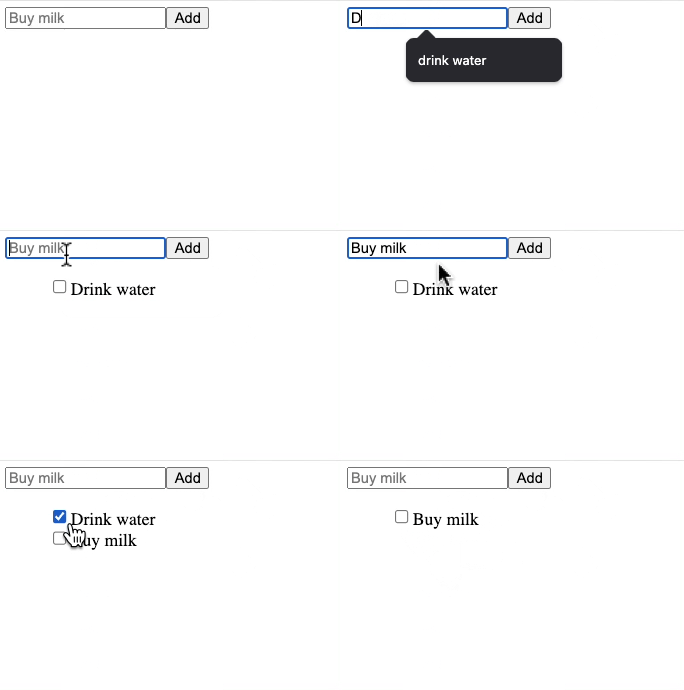
Section titled “1. To-Do App”A simple app that allows adding / completing tasks: View on CodePen ↗
2. Single HTML file Example
Section titled “2. Single HTML file Example”Here is an example of using a custom element in a single .html file.
<!doctype html><html lang="en">  <head>    <title>WC Base Test</title>    <script type="module">      import { WebComponent } from 'https://esm.sh/web-component-base@latest'
      class HelloWorld extends WebComponent {        static props = {          myName: 'World',        }        get template() {          return `<h1>Hello ${this.props.myName}!</h1>`        }      }
      customElements.define('hello-world', HelloWorld)    </script>  </head>  <body>    <hello-world my-name="Ayo"></hello-world>    <script>      const helloWorld = document.querySelector('hello-world')      setTimeout(() => {        helloWorld.props.myName = 'Ayo zzzZzzz'      }, 2500)    </script>  </body></html>
3. Feature Demos
Section titled “3. Feature Demos”Some feature-specific demos: